
Begin Your Fingerstyle Guitar Journey Now

Your Instructor
Hi, my name is Neil Chan and I've been playing and teaching fingerstyle guitar for over a decade.
From performing with world-class artists like Sungha Jung to teaching at the National University of Singapore, sharing the art of fingerstyle guitar has been my life's passion.
This course started with a desire to play any song on solo fingerstyle guitar immediately after listening to it.
After 5 years refining this technique with in-person students, I finally created the Fingerstyle for the World method.
Now, all the concepts are packaged in a structured course to learn at your own pace and comfort level.
6 Core Pillars
The Fingerstyle for the World curriculum is built upon
6 core pillars (musical concepts) and a firm foundation (fundamentals and boosters)
to unlock artistic freedom in fingerstyle arrangement through song tutorials.

Curriculum at a Glance


Why Choose Fingerstyle For The World?
Seamless Learning
Fingerstyle for the World is designed as a learning eco-system with 4 components working harmoniously help you learn, practice, apply and guide you in arranging your favourite songs in a way that is uniquely yours.

Hear from Existing Students

Fingerstyle For The World
VS
YouTube
Four Reference Guides
PACKED with all the tools taught for easy reference as you seamlessly create your own fingerstyle arrangements.


Fingerstyle For The World
VS
In-Person Lessons
Choose your Guitar Path

Not Ready for the Full Journey?
Take the first step by choosing a single level.
(Recommended to start at level 1)


Go the Extra Mile
(Includes all 3 levels + 2 online consultations)


Begin your guitar journey risk-free!
Fingerstyle for the World is backed with a 14 day money-back guarantee.
I'm confident that you will get so much value in this course for many years to come that you won't be disappointed, so I'm letting you begin your guitar journey risk-free!
If you find the course not suitable for you, simply drop me a message through the course page within 14 days of purchase and I will issue you a full refund, no questions asked.
Frequently Asked Questions
How did Fingerstyle for the World come about?
- It started with a frustration that I could sing a melody immediately upon hearing it, but could not play it on guitar. I then devoted five years creating a method to immediately play a song on solo fingerstyle guitar after hearing it, complete with melody, harmony, rhythm and improvisation.
Is Fingerstyle for the World for beginners?
- Yes! Fingerstyle for the World is designed to be accessible to beginners. Level 1 begins with three foundational chapters to lay the groundwork in technique, terminology and theory, while subsequent chapters introduce concepts progressively to ensure you can follow easily.
I already play the guitar, is Fingerstyle for the World still for me?
- Definitely! Whether you previously learned guitar from a school, teacher or are self-taught, you will find immense value in studying all these concepts in a structured and organised manner.
Even if some of the material is familiar to you, it is helpful to revise them in the context of applying them directly to fingerstyle arrangement.
What is the difference between the 3 levels of the course?
- The levels are designed to be progressive, equipping you with the necessary tools to arrange songs in a variety of styles.
Level 1: Arranging in open position using open chord shapes and scale positions.
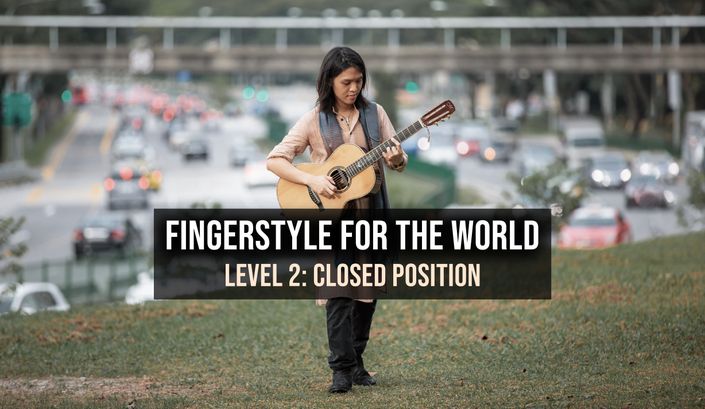
Level 2: Arranging in closed position using movable chord shapes and scale positions.
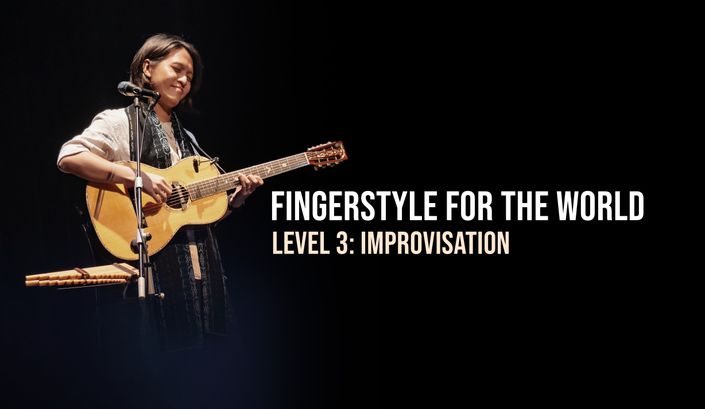
Level 3: Arranging with improvisation using a variety of approaches to make each arrangement uniquely yours.
What is the practice booster?
- Fingerstyle for the World is designed as an eco-system with 4 components to ensure a comprehensive learning experience:
1. Lessons (Knowledge)
2. Boosters (Practice)
3. Tutorials (Application)
4. Guides (Reference)
The booster shows you HOW to practice the knowledge learnt in the lessons, followed by tutorials that guide you in applying it to song arrangement with the aid of guides as easy reference to all the musical tools studied.
How much time do I need to spend to see results from this course?
- Consistent daily practice (even short durations) is superior than infrequent long stretches.
I recommend a minimum of 30 minutes a day, 5 days a week:
10 minutes to study course material and 20 minutes to practice it on guitar. Of course, the more time you spend each day, the better!
Why choose Fingerstyle for the World over in-person lessons?
-
Unlimited lifetime access.
You may not have access to a specialised fingerstyle guitar teacher in your area, while Fingerstyle for the World is accessible globally and for a lifetime after enrolling.
-
You save lots of money.
The material in a single level is what I teach in-person students in a year. That's over 50 weekly lessons! The cost of each level is roughly equivalent to only 3 in-person lessons. You can even enrol in all 3 levels for a further 50% discount.
-
Comfort and pace.
You can learn at the comfort of your own home at a pace that best suits you, reviewing each lesson as many times as required.
Is Fingerstyle for the World as effective as in-person lessons?
- It's different. While the content is the same, any online course will lack direct coaching. I won't check on your progress or give you direct in-person feedback. You need to be self-motivated to put in the hard work to reap the rewards of the course.
What if I'm not self-motivated?
- Here's the good news! You can submit one video per course level for me to give you direct feedback on your progress. This will provide you with the direct coaching element otherwise missing from other online courses.
Do I need a specific guitar to follow this course?
- While I recommend using a steel-string acoustic guitar, any 6-string guitar will do.
I noticed you use solfege singing for ear training. What if I'm not a singer?
- The solfege exercises are intended to train your ear and pitch memory, not your vocal technique. The focus is on using your voice to match notes with no regard to how beautiful it sounds (in other words, you don't need to be a singer).
Your voice is the best tool for ear-training, as singing a note forces you to first conceptualise it in your mind (the guitar can produce any note without you ever needing to hear it).